12 ACPE Credits
12 ANCC Contact Hours
$745.00 for Nurse Practitioners, Physician Assistants, Pharmacists
$595.00 for Nurses, Pharmacy Technicians
OUR OFFICE HOURS
Mon-Fri 8:30am-6:00pm EST
Sat 10:00am-2:00pm EST
Our staff can assist you with all your travel arrangements.
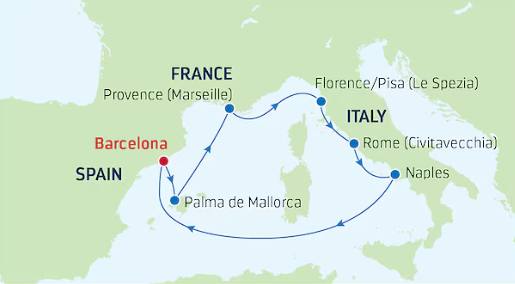
| DATE | PORT OF CALL | ARRIVE | DEPART |
|---|---|---|---|
| Sun Jun 07 | Barcelona, Spain |
- | 5:00 pm |
| Mon Jun 08 | Palma De Mallorca, Spain Lectures 1:00 PM - 5:00 PM |
8:00 am | 4:00 pm |
| Tue Jun 09 | Provence (Marseille), France Lectures 8:00 AM - 9:00 AM |
9:00 am | 6:00 pm |
| Wed Jun 10 | La Spezia, Italy |
8:30 am | 8:00 pm |
| Thu Jun 11 | Rome (Civitavecchia), Italy |
7:00 am | 7:00 pm |
| Fri Jun 12 | Naples, Italy |
7:00 am | 7:00 pm |
| Sat Jun 13 | *At Sea - Cruising Lectures 8:00 AM - 12:00 PM, 1:00 PM - 4:00 PM |
- | - |
| Sun Jun 14 | Barcelona, Spain |
5:00 am | - |
Barcelona, Spain - For travelers fortunate enough to begin or end their voyage in Barcelona, we offer a crucial piece of professional advice: do not treat this city merely as a logistical bookend. To arrive only hours before embarkation or to fly out immediately upon docking is to miss the very soul of Catalonia. Barcelona is not simply a port; it is one of Europe’s most sophisticated, visually stunning, and culturally distinct capitals. We strongly recommend framing your cruise with a minimum of two to three nights here. This allows the city’s vibrant, artistic, and culinary culture to unfold at a human pace, rather than a frantic tourist sprint. Barcelona rewards immersion. It is a city of stark, beautiful contrasts: grand 19th-century boulevards abutting hidden medieval alleys; avant-garde design coexisting with centuries-old traditions; and a Mediterranean spirit of leisure blended with fierce Catalan pride. Below is a curated, unhurried itinerary designed to help you experience the best of the city before or after your voyage. ### Day 1: The Ancient Heart – Gothic Quarter & El Born Begin your immersion by losing yourself in the **Barri Gòtic (Gothic Quarter)**. This is the historical nucleus of Barcelona, a captivating labyrinth of narrow, winding streets that open unexpectedly onto sun-drenched plazas. While the **Barcelona Cathedral** is a soaring example of Catalan Gothic architecture (and worth a visit to see the 13 geese in the cloister), the real joy here is aimless wandering. Look for the **Temple of Augustus**, where four Roman columns remain hidden inside a medieval building—a quiet reminder of the city’s ancient origins as 'Barcino.' Adjacent to the Gothic Quarter is the trendier, more bohemian district of **El Born**. It shares the medieval layout but possesses a distinct artistic vitality. Here you will find the **Museu Picasso**, housed across five adjoining medieval palaces. It offers an unparalleled look into the artist's formative years. A short walk away stands the **Basilica de Santa Maria del Mar**, a church built by the people for the people, and a masterpiece of pure Gothic proportions. El Born is also a culinary hotspot; we recommend spending your evening here hopping between wine bars for *pintxos* (Basque-style tapas) and local Cava. ### Day 2: The Modernist Visionaries Today is dedicated to the architectural movement that defines Barcelona: *Modernisme*. Naturally, this begins with Antoni Gaudí’s magnum opus, **La Sagrada Família**. **Critical Advice:** You must book your tickets online weeks, if not months, in advance. This is not a suggestion; it is a necessity. While the exterior is a marvel of symbolic sculpture, the interior is where the true magic lies. Stepping inside is like entering an ethereal forest, with columns branching like trees and kaleidoscopic light filtering through stained glass. It is a profound, spiritual experience. However, for our clients—particularly those in the medical or architectural fields—we strongly recommend a visit to the **Recinte Modernista de Sant Pau**. Just a short walk from the Sagrada Família, this former hospital (designed by Lluís Domènech i Montaner) is a UNESCO World Heritage site often overlooked by the masses. It is a stunning complex of colorful pavilions and gardens designed to heal the spirit as well as the body. It is arguably one of the most beautiful Art Nouveau complexes in the world and offers a tranquil counterpoint to the bustle of Gaudí’s basilica. In the afternoon, stroll down the **Passeig de Gràcia**, Barcelona’s answer to the Champs-Élysées. Here you will find Gaudí’s residential masterpieces: **Casa Batlló**, with its dragon-scaled roof, and **Casa Milà (La Pedrera)**, with its undulating stone facade. Both require advance booking for interior tours, though the exteriors alone are worth the walk. ### Day 3: Views, Art, and the Sea If your schedule permits a third day, head to **Montjuïc**, the broad hill overlooking the harbor. You can reach it via a scenic cable car ride from the port area. This area is home to the **Fundació Joan Miró**, a bright, airy museum dedicated to Barcelona’s other famous artistic son. The views from the castle at the summit offer a perfect perspective on the city layout and the port where your ship awaits. Finish your stay in **La Barceloneta**, the seaside neighborhood. While touristy on the main boardwalk, the backstreets retain a salty, local charm. This is the place for a farewell lunch of *fideuà*—a local twist on paella made with short noodles instead of rice, served with dollops of garlic aioli. ### The Culinary Scene: Dining Like a Local Barcelona is a food lover’s paradise, but timing is everything. Lunch is the main meal (2:00 PM – 3:30 PM), and dinner is late (rarely before 9:00 PM). * **The Market Experience:** The famous **Mercado de La Boqueria** is visually stunning but often overwhelmingly crowded. For a more authentic experience, we recommend the **Mercat de Santa Caterina** in El Born, identifiable by its wavy, colorful mosaic roof. It is a fantastic place to see locals shopping and to grab a superb lunch at the market bar, *Cuines Santa Caterina*. * **Fer el Vermut:** Participate in the beloved local ritual of "doing the vermouth." Before lunch, find a bodega and order a *vermut de la casa* (sweet red vermouth over ice with an olive and orange slice) accompanied by chips and cockles. It is the quintessential Catalan aperitif. ### Practical Logistics for the Cruiser Barcelona is wonderfully easy to navigate, but the port logistics require specific attention. * **Port Location:** The main cruise terminal, **Moll Adossat**, is located on a very long breakwater. **Do not attempt to walk to the city center from the ship.** It is much further than it looks (nearly 2 miles to the Columbus monument) and is an exposed, industrial walk over a bridge. * **Transfers:** A **taxi** is the most direct option and costs roughly €35-€40 from the airport to the city, or €15-€20 from the city to the ship. Alternatively, the blue **Portbus (T3)** shuttle runs from the Columbus Monument at the foot of Las Ramblas directly to the terminals for a nominal fee. * **Safety:** Barcelona is generally safe, but it is infamous for skilled pickpockets, particularly on Las Ramblas, the Metro, and in the Gothic Quarter. Be vigilant with watches, phones, and wallets. Leave expensive jewelry in your hotel or ship safe. * **Getting Around:** The city is very walkable, but the **Metro** system is clean, air-conditioned, and efficient. A multi-day "Hola Barcelona" card is a great investment for exploring. By allowing yourself this extra time, you transform Barcelona from a mere departure point into a highlight of your vacation. It is a city that deserves to be savored, and you deserve the time to do it right.
Palma De Mallorca, Spain - Palma de Mallorca is frequently the sleeper hit of a Western Mediterranean itinerary. While often anticipated merely as a beach resort, the Balearic capital reveals itself as a sophisticated urban center with an architectural pedigree rivaling mainland Spain. It offers a compelling blend of Gothic grandeur, modernist flair, and a relaxed island pace that appeals to those who appreciate culture without the frenetic energy of larger metropolises. The skyline is dominated by the Catedral-Basílica de Santa María, known locally as La Seu. This sandstone leviathan is essential viewing, not just for its exterior dominance but for the interior dialogue between history and modernity; Antoni Gaudí’s unfinished wrought-iron canopy hangs above the altar, while Miquel Barceló’s ceramic chapel adds a controversial contemporary layer. Just below, the Parc de la Mar offers the perfect vantage point for photography. Beyond the cathedral lies the Casco Antiguo (Old Town), a labyrinth of narrow streets best explored without a map. Look for the traditional Mallorcan courtyards (patios) visible through iron gates of aristocratic homes. A stop at the Banys Àrabs (Arab Baths) provides a quiet glimpse into the city’s Moorish past. For a pause, the tree-lined Passeig del Born is the city’s living room, ideal for coffee and people-watching. For panoramic context, a taxi to Castell de Bellver is recommended. As one of Europe’s few circular castles, it offers 360-degree views of the bay and pine forests. Regarding logistics: The cruise pier is an industrial stretch about three miles from the historic center. We strongly advise utilizing a taxi or the port shuttle rather than attempting the walk, maximizing your time for tapas and exploration.
Provence (Marseille), France - Marseille is not a polished museum piece; it is France’s oldest and second-largest city, a vibrant, working port with a palpable energy and a history stretching back 2,600 years. Its character is a compelling mix of grit and grandeur, offering a genuine slice of Mediterranean life. The natural starting point is the Vieux Port (Old Port), a bustling U-shaped harbor where fishing boats bob alongside yachts. Here, the daily fish market is a spectacle of local life, and the surrounding quays are lined with cafés perfect for observing the city in motion. For the definitive view, make the journey up to the Basilique Notre-Dame de la Garde. This Romano-Byzantine basilica, affectionately called "La Bonne Mère" (The Good Mother), offers breathtaking 360-degree panoramas of the city, the sea, and the surrounding islands. We recommend taking the tourist train or a taxi for the steep ascent to conserve time and energy. Back at sea level, lose yourself in Le Panier, the city's oldest quarter. Its maze of narrow, winding streets, ochre-colored buildings, and artisan workshops feels a world away from the grand 19th-century boulevards elsewhere. Marseille also serves as the essential gateway to the broader Provence region. A popular day excursion leads to the elegant city of Aix-en-Provence, the refined counterpoint to Marseille's urban dynamism, known for its fountains, markets, and ties to the artist Cézanne. Alternatively, for a stunning natural escape, head to the charming fishing village of Cassis, the launching point for boat tours into the Calanques National Park—a series of dramatic limestone fjords with brilliant turquoise water. Whether you immerse yourself in the city's layered history or venture into the Provençal countryside, Marseille offers a rich and authentic experience.
La Spezia, Italy - An overnight stay in La Spezia transforms this working naval port from a simple transit point into a strategic, stress-free command center for exploring two of Italy’s most celebrated regions. While La Spezia itself is an industrial city rather than a polished tourist hub, its logistics are unrivaled. The extended time in port removes the anxiety of the 'all-aboard' clock, allowing for a deep, two-part exploration of Tuscany and the Ligurian Riviera that single-day visitors simply cannot manage. For your first day, the extended hours make a trip to Florence (Firenze) a viable and rewarding option rather than a rushed blur. Direct trains from La Spezia Centrale take approximately two and a half hours. With the luxury of a late return, you can move beyond a quick photo of the Duomo. Pre-book entry to the Accademia to see Michelangelo’s David or explore the Uffizi Gallery without panic. The true advantage of the overnight is the ability to enjoy an authentic Florentine dinner—perhaps a *Bistecca alla Fiorentina*—after the day-trippers have fled, catching a late train back to the ship in comfort. Alternatively, for a more relaxed pace, consider the walled city of Lucca, located about an hour away. Renting a bicycle to ride atop the Renaissance-era city walls offers a civilized, sophisticated experience that contrasts sharply with the crowds of Pisa. Upon returning to La Spezia, or perhaps for your evening meal, embrace the local rhythm. The city comes alive during the evening *passeggiata* along the palm-lined Passeggiata Costantino Morin. This is the time to live like a Ligurian. Seek out a trattoria away from the immediate waterfront to try genuine Pesto alla Genovese—born in this region—served over fresh trofie pasta. Pair it with a glass of local Vermentino white wine or a Sciacchetrà dessert wine. Do not miss the chance to try *farinata*, a savory chickpea pancake that is a staple street food here. On your second day, the dramatic coastline of the Cinque Terre is the priority. The 'Cinque Terre Express' train is the most efficient way to hop between the five villages (Riomaggiore, Manarola, Corniglia, Vernazza, and Monterosso), running frequently from La Spezia Centrale. However, for a more scenic and sophisticated approach, we highly recommend taking the ferry from the La Spezia harbor. Approaching the villages from the water provides a breathtaking perspective of the colorful houses clinging to the cliffs that trains inside tunnels simply miss. For those who have already seen the Cinque Terre or wish to avoid the heaviest crowds, the village of Portovenere is a spectacular alternative. Accessible by ferry or bus (no train), it is a UNESCO World Heritage site that often feels more exclusive. The sight of the Gothic Church of San Pietro perched on the rocky headland and the imposing Doria Castle offers history and beauty on par with its famous neighbors, but with a slightly more relaxed atmosphere. Before departing, if time permits, the Naval Technical Museum in La Spezia offers a fascinating look at the city’s maritime heritage, featuring figureheads and naval weaponry that appeal to history enthusiasts. La Spezia may be the gateway, but with 36 hours, it becomes the key to an unforgettable Italian immersion.
Rome (Civitavecchia), Italy - Civitavecchia serves a singular purpose: it is the industrial gateway to Rome. The Eternal City lies roughly 75 to 90 minutes away by road or rail, making your time ashore a logistical challenge that rewards strategy over spontaneity. We cannot overstate the importance of this commute; treat the journey as a tactical necessity to access one of the most culturally dense cities on earth. With a typical port day, attempting to see 'everything' guarantees nothing but exhaustion. We strongly recommend curating your day around one of three distinct tracks to ensure a quality experience. First, the Imperial Track. Focus on the Colosseum, the Roman Forum, and Palatine Hill. Walking the Via Sacra offers a tangible connection to the origins of Western law and governance. However, admission lines here can consume hours; pre-purchased, timed-entry tickets are not optional—they are essential. Second, the Vatican Track. St. Peter’s Basilica and the Vatican Museums hold an overwhelming concentration of artistic wealth. Standing beneath Michelangelo’s Sistine Chapel ceiling is profound, but the crowds are equally intense. Strict dress codes (shoulders and knees covered) are enforced, and guided access is the only way to navigate the vast collections efficiently within a limited window. Third, the Centro Storico. For those who prefer atmosphere over checklists, a walking tour of the historic center offers a more relaxed pace. Start at the Pantheon—the world’s best-preserved ancient building—then wander to Piazza Navona and the Trevi Fountain. This approach allows time for a proper Roman lunch. Avoid restaurants directly facing major monuments; walk two streets back to find authentic cacio e pepe or carciofi alla giudia (Jewish-style artichokes). A rushed sandwich does a disservice to Italian culinary heritage, whereas a seated meal offers a necessary respite from the sensory overload. Regardless of your choice, Rome demands respect for the clock. Always build a significant buffer for your return trip to Civitavecchia to ensure a stress-free conclusion to a spectacular day.
Naples, Italy - Naples is a destination that demands a choice: do you dive into the chaotic, vibrant heart of the city, or use it as a strategic launchpad for the world-class treasures surrounding it? As a port of call, Naples offers an embarrassment of riches, but the sheer volume of options requires a disciplined itinerary. The most critical advice we can offer is to resist the urge to do everything; traffic in Campania is notorious, and overpacking your day often leads to stress rather than enjoyment. For history enthusiasts, the primary draw is the shadow of Mount Vesuvius. Pompeii remains the headline attraction, offering a sprawling, visceral look at Roman life frozen in time. However, we often direct clients toward the smaller, better-preserved site of Herculaneum. Because it was buried in mud rather than ash, Herculaneum retains multi-story buildings and wooden elements that perished in Pompeii, all within a footprint that is much easier to navigate in a few hours. If you prefer coastal glamour, the Bay of Naples is your gateway. A high-speed hydrofoil can transport you to the Isle of Capri, famous for the Blue Grotto and high-end boutiques, though be mindful of summer crowds. Alternatively, the cliffside town of Sorrento offers a refined, relaxed atmosphere perfect for a leisurely lunch of fresh seafood and limoncello. While the Amalfi Coast is spectacular, we advise caution when attempting it on a cruise stop; the winding roads are breathtaking but slow, leaving little room for error in your return schedule. Should you choose to stay in Naples itself, prepare for an experience that is gritty, loud, and profoundly authentic. The historic center, Spaccanapoli, is a UNESCO World Heritage site teeming with baroque churches and hidden courtyards. The National Archaeological Museum is essential viewing, as it houses the actual mosaics and artifacts removed from the excavation sites. Finally, this is the birthplace of pizza. Skipping a meal at a historic pizzeria here would be a missed cultural imperative.
At Sea - Cruising -
Our staff can assist you with all your travel arrangements.
Questions? Call us at 800-422-0711.